
On behalf of Videre Tekstil AS, NORSIRK’s new producer responsibility organisation for textiles, the knowledge base on textiles, textile consumption and textile waste in Norway is currently being updated.
The updated report has been prepared by NORSUS and builds on previous mappings of textile flows in Norway. The ambition is for this to evolve into an annual status report, providing businesses, authorities and other stakeholders with an increasingly robust knowledge base in the years ahead.
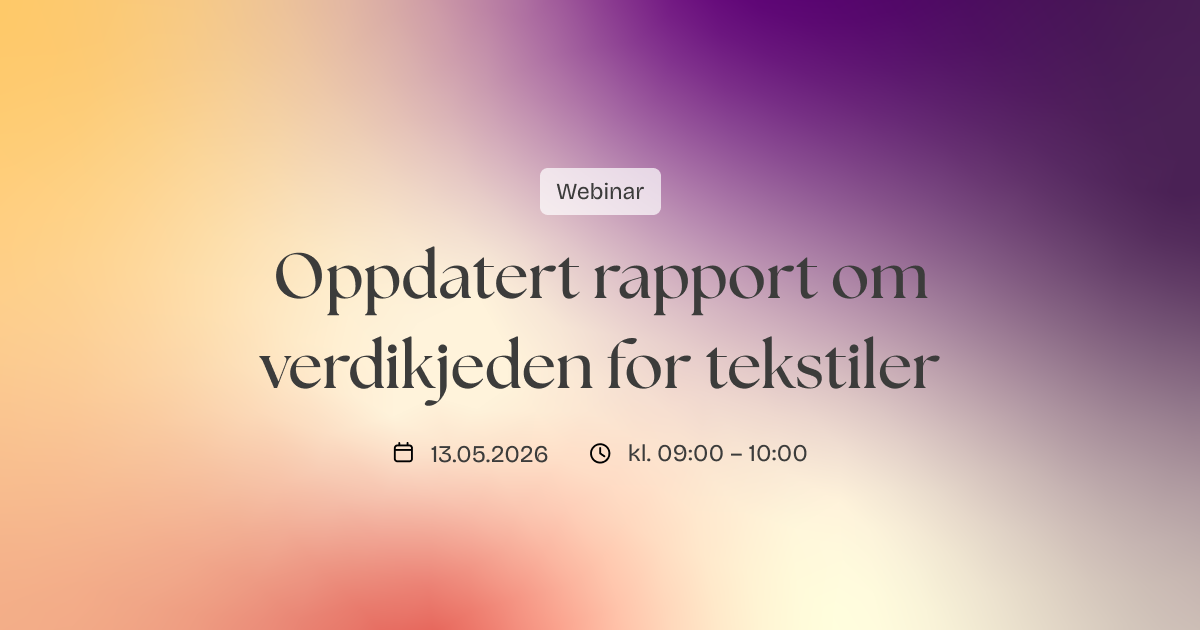
Presented in a Webinar on 13 May
The new report will be presented in an open webinar on 13 May from 09:00 to 10:00, where NORSUS will present the main findings and explain how the data has been collected and analysed.
Register for the webinar here.
We spoke with NORSUS Research Director Irmeline de Sadeleer about this year's update.
"One of the most interesting developments in this year's update is that we now have data related to online textile sales. This is something we did not have previously. The figures are still uncertain, but they indicate that e-commerce represents a significant share of the market and is something that should be monitored more closely going forward," says de Sadeleer.
She also highlights that the report includes Norwegian figures on textile recycling for the first time.
"We now have national data on textile recycling, which provides a more up-to-date picture of developments across the value chain."
This year's main analysis focuses on the product categories that will be covered by the forthcoming Extended Producer Responsibility (EPR) scheme for textiles. As a result, the figures in the main section of the report are not directly comparable with previous studies.
"By limiting the analysis to products covered by producer responsibility, we are working with a different dataset than before. Therefore, direct comparisons should be made with caution," explains de Sadeleer.
To preserve the possibility of comparing developments over time, an extended analysis has also been carried out.
"We have conducted a parallel analysis with a broader product scope, allowing developments to be compared with the previous report."
"Perhaps how challenging it still is to obtain reliable data. There is a great deal of information available, but not always data that is comparable or complete. Gathering, validating and understanding the underlying figures takes time," she says.
She points in particular to differences in reporting practices among stakeholders and notes that some areas still lack robust national data.
"For example, it remains difficult to gain a complete overview of local collection activities, reuse practices and the different sorting stages."
Previous studies attracted considerable attention for showing relatively low levels of textile reuse in Norway. Better statistics are still needed in this area.
"We can see that there is more activity taking place than is necessarily reflected in the available figures. Reuse occurs through collection organisations, second-hand stores, digital marketplaces and local initiatives. There is still significant potential to improve the underlying data."
The upcoming EPR scheme may also contribute to better statistics and more accurate reporting.
"When producer responsibility is implemented, it will be accompanied by reporting requirements. This should make future mapping exercises both easier and more precise," says de Sadeleer.
Videre Tekstil and its partners are now considering further developing the report into an annual national status report on textiles in Norway.
The goal is for the report to be improved year by year and provide increasingly robust insights into:
Such an annual update could become an important tool for businesses, authorities and organisations working to develop circular solutions for textiles.
Register for the webinar here.
Read more about Videre Tekstil AS here.