

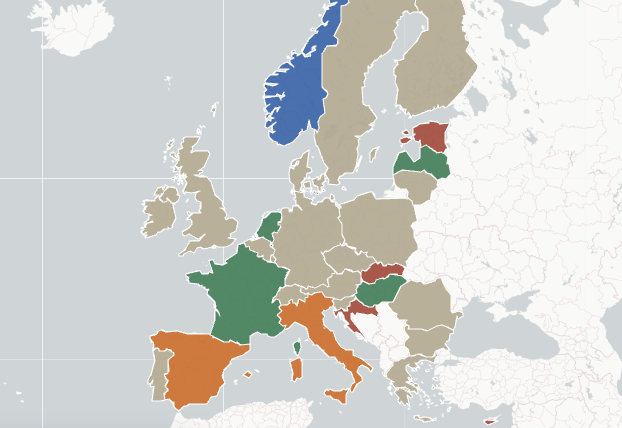
Building on the revised Waste Framework Directive (WFD), the European Union adopted a framework for Extended Producer Responsibility (EPR) for textiles in October 2025 that will apply across all EU/EEA Member States.
The framework aims to ensure that producers contribute financially to the collection, sorting, reuse, and recycling of used and discarded textiles and footwear. At the same time, EPR schemes are intended to encourage more circular textile value chains and support the transition to a more sustainable textile industry.
The coming years will be critical for the rollout of textile EPR across Europe:
While the EU sets the overall framework, the design and implementation of EPR schemes remain largely the responsibility of individual countries.
Europe is currently at very different stages in the implementation of textile EPR.
Some countries already have operational producer responsibility schemes in place. Others are well advanced in their legislative processes, with draft regulations or public consultations underway, as is the case in Norway. Many Member States are still engaged in policy discussions, with implementation expected between 2027 and 2028. A number of countries currently have only limited or no visible initiatives.
These differences reflect variations in national waste management systems, market structures, and political priorities. At the same time, they highlight the need for coordination and harmonisation to ensure a level playing field for businesses operating across borders.
To provide a clear overview of this rapidly evolving landscape, the EURATEX Textile PRO Forum has developed a dynamic map of textile EPR initiatives across Europe.
The map allows users to explore:
Explore the map to view the latest developments in each country:
Textile EPR in Europe Interactive Map